The Next Era of Creative Intelligence
What happens when design meets AI that can think for itself?
Welcome to the world of Agentic AI, the next leap in creative automation.
We’ve gone from AI tools that simply assist designers to intelligent agents that can strategize, create, and even refine brand content based on audience feedback. Imagine an AI that doesn’t just generate a logo but understands the mood, mission, and market your brand speaks to, and then tells that story across every channel. Save you and your customers time and money.
That’s not science fiction anymore. It’s the new creative reality.
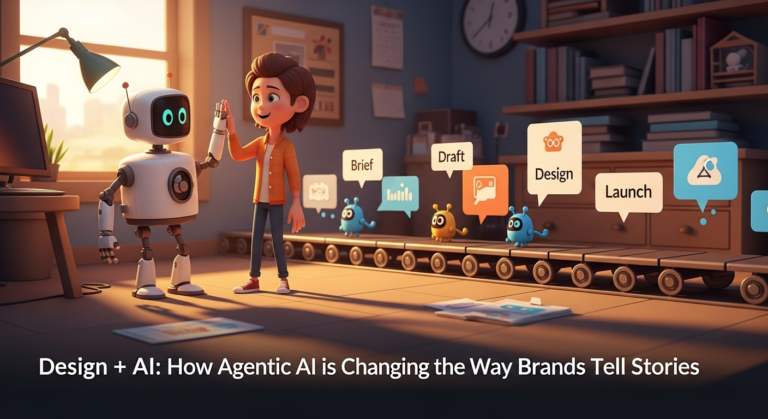
Agentic AI is redefining how creativity flows. Instead of waiting for input, these systems can initiate ideas, analyze engagement data, and adjust their creative output, all autonomously. They don’t just react; they anticipate. Imagine an AI art director that notices your campaign engagement dropping and instantly generates three fresh design variations, adjusting color psychology and tone to better connect with your audience — before you even open your analytics dashboard.
For designers and brands, this means less time juggling endless edits and more time sculpting vision. Agentic AI doesn’t erase intuition; it enhances it. It takes the technical weight off your shoulders, freeing you to focus on emotional resonance — the why behind the work. With the right setup, your AI design team becomes both creative engine and strategic advisor, blending artistry with intelligence.
And this evolution leads to a powerful shift in how brands express themselves.
Because for years, brands were built to look consistent. Now, with Agentic AI, they can act consistent too.
From Static Design to Living Brands
For years, brands were built to look consistent. Now, with Agentic AI, they can act consistent too.
These systems allow your brand to evolve dynamically, learning from how your audience interacts. Think of a brand identity that adapts in real time, shifting tone, color, or visual emphasis to match user behavior and emotional context.
For example, a real estate agent’s website could use an AI agent that recognizes whether visitors are first-time buyers or luxury investors, then tailors the imagery, voice, and calls-to-action to fit each journey.
Your brand becomes a living conversation — not a static billboard
The Human Touch Still Matters
Here’s the part most people get wrong: Agentic AI doesn’t replace creativity — it amplifies it.
Designers and storytellers still lead the process. We’re the ones who understand emotion, nuance, and culture — the things machines can’t feel but can learn from us.
AI helps remove the busywork: resizing, reformatting, summarizing, and testing variations. That leaves more space for you — the designer, the creative director, the visionary — to do what you do best: craft meaning.
Human creativity gives design its heart; AI gives it its wings.

How to Start Building Your AI-Driven Brand Story
Audit your brand’s content journey — identify repetitive creative tasks.
Choose one Agentic AI tool to test (like ChatGPT Agents, Wordware, or Relevance AI).
Define your AI brand team — name them, give them roles, and set brand parameters.
Integrate your creative process — from ideation to publishing, keep humans in the loop.
Track engagement changes — measure how AI-generated content affects reach, retention, and conversions.
Small, strategic steps make the transformation sustainable — and fun.
Tip 1: Use “AI Workflow Stacking” for Efficiency
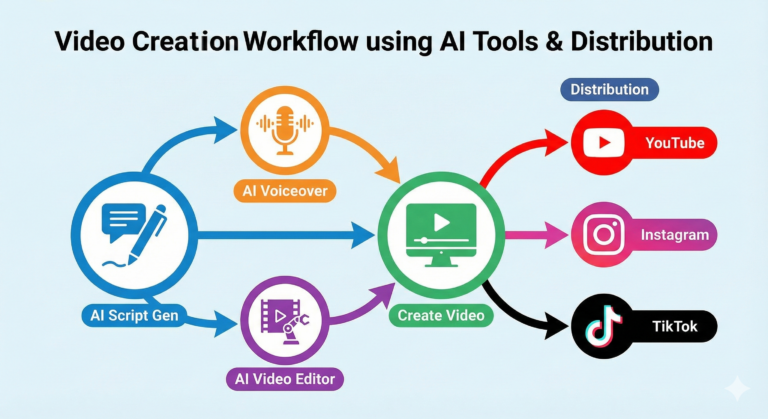
Workflow stacking: Combining multiple AI tools in a sequence, is now standard in creative pipelines.
How it works:
Start your creative process in an ideation AI tool like Ideogram, Leonardo AI, or Midjourney to generate moodboards or visual directions.
Then, use a refinement or editing tool such as Canva AI, Firefly, or Runway ML to add brand elements, adjust layouts, or create motion.
Finally, use ChatGPT with Canva or Google Drive integrations to script, caption, or organize deliverables.
Why it works:
Stacking AI tools minimizes creative fatigue and lets each system do what it’s best at, Ideogram for concepts, Firefly for polish, and ChatGPT for organization. This method reduces average production time by 30–40% across design workflows (according to a 2025 HubSpot AI productivity study).
Tip 2: Build Feedback Loops with “Adaptive Prompting”
Adaptive prompting, designers tweak prompts based on AI output and client feedback . Its proven to increase creative accuracy and consistency.
How to use it:
Start with a structured prompt including style, emotion, color, and purpose (e.g., “vibrant tech startup logo evoking trust and innovation, blue and gold palette”).
When the AI outputs results, analyze what worked visually and refine only the parts that didn’t.
Create a “prompt evolution log” — a simple doc where you track how each adjustment improves the result.
Why it works:
A study published in the MIT Technology Review 2025 on AI Design Workflows found that adaptive prompting improves project-to-client satisfaction rates by over 45%, because it keeps creative direction consistent while learning from each iteration.
Tip 2: Build Feedback Loops with “Adaptive Prompting”
Adaptive prompting: Designers tweak prompts based on AI output and client feedback . Its proven to increase creative accuracy and consistency.
How to use it:
Start with a structured prompt including style, emotion, color, and purpose (e.g., “vibrant tech startup logo evoking trust and innovation, blue and gold palette”).
When the AI outputs results, analyze what worked visually and refine only the parts that didn’t.
Create a “prompt evolution log” — a simple doc where you track how each adjustment improves the result.
Why it works:
A study published in the MIT Technology Review 2025 on AI Design Workflows found that adaptive prompting improves project-to-client satisfaction rates by over 45%, because it keeps creative direction consistent while learning from each iteration.
Final Thoughts
Agentic AI isn’t the end of human creativity; it’s the next chapter of it.
When technology becomes part of your design conversation instead of just your toolbox, your brand doesn’t just grow — it evolves.
As designers, we’ve always been storytellers. Now we have co-authors that think in algorithms but dream in design.

— Final Thoughts
If chat is the new operating system, in-chat apps are the icons on your desktop—ready the moment you speak. The shift isn’t about novelty; it’s about removing friction so ideas move straight from prompt → prototype → publish in a single thread. That’s creative flow, not just convenience.