If you have spent any time online this year, you have heard the word “agent.” AI agents that book meetings, AI agents that write your emails, AI agents for every job you can name. So it caught a lot of people off guard when two engineers from Anthropic, the company behind Claude, stood on stage and told a room full of developers to stop building them.
The talk, “Don’t Build Agents, Build Skills Instead”, was given by Barry Zhang and Mahesh Murag at the AI Engineer Code Summit and has been watched close to a million times. I watched it twice. Here is what they said, and what it means if you run a business and want AI to actually save you time.
The problem isn’t intelligence. It’s expertise.
Barry and Mahesh open with a simple question: who would you rather have do your taxes, a genius mathematician with a 300 IQ, or an experienced tax professional? Everyone picks the tax pro. The genius could work out the tax code from first principles, but you don’t want them to. You want someone who already knows the rules, the forms, and the shortcuts.
That is where most AI tools are today. The models are brilliant, but they show up to your business knowing nothing about how you do things: your brand voice, your pricing, how you onboard a client, what your invoices look like. So every time you open a chat, you start from zero and explain it all again.
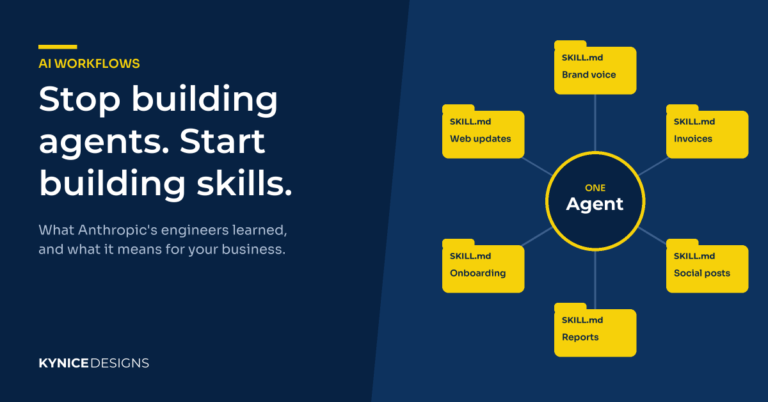
The industry’s answer has been to build a separate agent for each job, one for marketing, one for support, one for bookkeeping, each with its own setup. Anthropic’s point is that this is the wrong move. Underneath, those agents are mostly the same thing. What is actually different between them is the know-how.
So what is a “skill”?
A skill is almost disappointingly simple, and the speakers say that is on purpose. It is a folder. Inside the folder is a main instruction file called SKILL.md that explains how to do one kind of task well, plus anything that helps: templates, examples, reference documents, even small scripts the AI can run.
Instead of building ten agents, you keep one capable AI assistant and give it a library of skills. When a task comes in, it pulls out the right folder and follows your playbook.
A few details from the talk make this practical rather than theoretical:
- It only reads what it needs. The AI sees a short description of every skill up front and only opens the full folder when a task calls for it. Anthropic calls this “progressive disclosure.” It means you can keep hundreds of skills on hand without overwhelming the assistant.
- Skills can hold real tools, not just notes. The speakers describe Claude rewriting the same slide-formatting script again and again, until they saved that script into a skill so it could simply be reused.
- They are easy to share. Because a skill is just files, you can keep it in Google Drive, zip it up, or hand it to a team member. When you improve it, everyone benefits.
- They work alongside connections to your apps. Anthropic’s Model Context Protocol (MCP) is what connects an AI to tools like your calendar, CRM, or website. Their framing: connections give the AI access, skills give it the expertise to use that access well.
They also offered a helpful comparison. The AI model is like a computer’s processor: powerful, but not much use on its own. The agent is like the operating system. Skills are the apps. And just like apps, the real value comes from the huge number of people building them for their own needs.
Who is building skills? Not just developers.
This was the part of the talk that stood out most to me. In the few weeks after skills launched, thousands were created. Big companies are using them to capture “how our team does things” so new hires start with that knowledge built in. Tool makers like Notion and Browserbase have published skills for their products.
But the speakers were most excited about who else showed up: people in finance, recruiting, accounting, and legal, people who don’t write code, building skills for their own work. That is the shift. You don’t need to be an engineer to teach AI your process. You need to be good at your job and able to write down how you do it.
What this means for your business
Here is my take. For most small businesses, the “agent” hype has been a distraction. You don’t need a fleet of AI bots. You need one dependable assistant that knows how your business runs. Skills are the clearest path to that I have seen.
What about my own AI team?
That might sound surprising coming from me. Over the past year I built my own AI team for Kynice Designs, a group of chatbots and assistants that help with marketing, social media, client questions, and more. I’m keeping every one of them. They have history with my business, they remember how I work, and they already have skills built in. Starting over would mean throwing all of that away.
And the timing could not be better, because the rest of the industry is moving the same way. OpenAI is retiring custom GPTs, the chatbots many of us built inside ChatGPT, and moving them into reusable skills and plugins. Several of my assistants live there, so they are about to become skills anyway. I am not worried about losing their history, either. When I created each one, I saved all of their original files and instructions on my own computer, so everything that makes them who they are is already safe and ready to carry over. If you have built chatbots of your own, now is a good time to do the same.
The win is that they keep their personality. Each assistant on my team has a persona: a name, a voice, and a way of working with me and my clients. That persona simply becomes part of the skill. Same expertise, same personality, now packaged the way Anthropic describes, as know-how that one capable assistant can pick up whenever the task calls for it.
What this talk changed is what I do next. I won’t be adding more assistants, because I don’t need to. I probably won’t use every one of them all the time, either, and that’s fine. Instead, my time goes into building up their skills. Each time I improve a skill, every assistant that uses it gets better. That’s really the point of the talk: you don’t need a bigger team, you need a smarter playbook.
Think about the tasks you explain over and over:
- Brand voice: how you write, words you never use, how you sign off.
- Social posts: your format, hashtags, call to action, and posting rhythm.
- Client onboarding: the welcome email, the questionnaire, the folder structure, the first-week checklist.
- Proposals and invoices: your packages, your terms, your layout.
- Website updates: how a new service page or blog post should look and be formatted.
Each of those can become a skill. Write it down once, add a good example or two, and your assistant follows it every time. There is a bonus, too: the act of writing your process down is valuable on its own. It is the same documentation you would want if you ever hired help.
A simple way to start this week
- Pick one repeat task. Choose something you do at least weekly and explain to AI more than once.
- Write the playbook. In plain language, list the steps, the rules, and what “good” looks like. Paste in one real example of finished work.
- Test it and tighten it. Run it a few times. Every time the result misses, add a line to the instructions instead of fixing it by hand.
- Add the next one. Once the first skill is reliable, move to the next task. Your library grows, and your assistant gets more useful every month.
The bottom line
Anthropic’s message wasn’t that agents are bad. It is that the smart investment is in expertise you can package, reuse, and keep improving, not in rebuilding the same assistant over and over. For small businesses, that is good news. Your know-how is the most valuable thing you have, and now there is a simple, practical way to put it to work.
If you would like help turning your processes into AI skills and workflows that actually save time, that is exactly what we do. Explore our AI Tools & Workflows services or reach out to start a conversation.
Source: “Don’t Build Agents, Build Skills Instead,” Barry Zhang and Mahesh Murag, Anthropic, AI Engineer Code Summit (December 2025). Watch the full talk on YouTube.